
Retreat Belmont Abbey 2. From Meditation to the beginning of Mystical Contemplation
Friday, September 5th, 2025
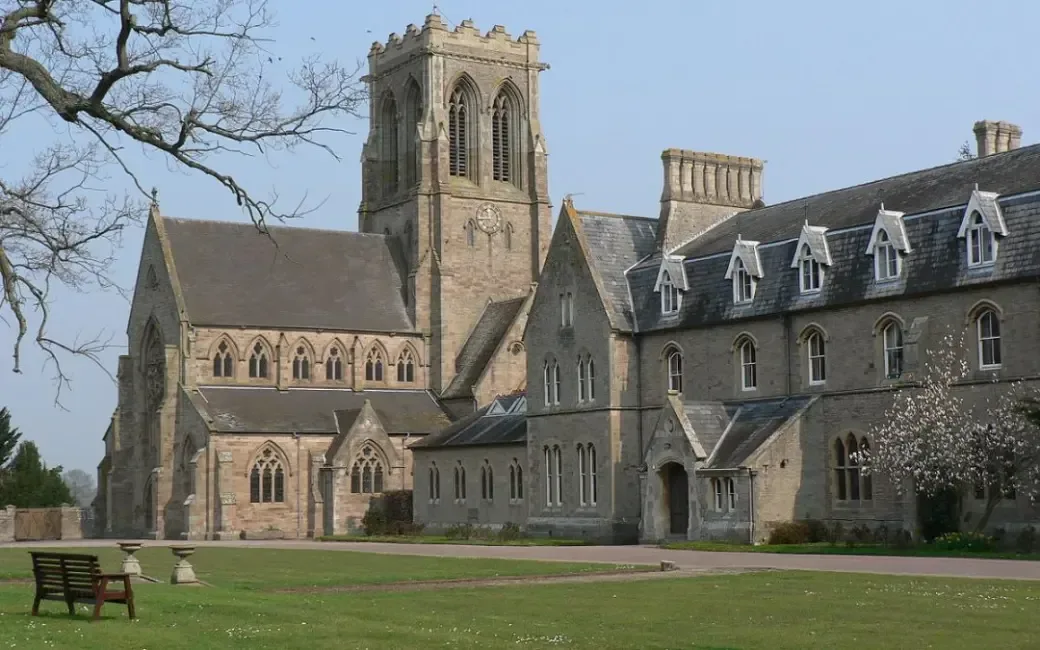
Belmont Abbey | Benedictine Monastery, Hereford UK
The second in a series of talks on Mystical Prayer. Given by David Torkington to members of the laity at Belmont Abbey, Herefordshire, England.
2. From Meditation to the beginning of Mystical Contemplation
Each morning after his mother’s death, David’s father brought two cups of tea into his bedroom. Sitting on his bed, David’s father told him the story of his love for his mother. It was for David a moving story in which he came to see how marriage is a unique analogy enabling him to understand Mystical Prayer like never before. It is this moving analogy that makes this talk not only profoundly meaningful, but deeply inspiring for everyone who has tried to give themselves to another in selfless love no matter what the cost.
Non nobis Domine, Domine, Non nobis Domine, Sed nomine, sed nomine tuo da gloriam:
Not to us lord, not to us, but to thy name let the glory be given:
Transcript of the Recording.
A Marital Analogy
Some years ago, I went to make a retreat in Franciscan Italy at a little hermitage called Fonte Colombo, near Rieti, in what is called the Holy Valley. It was the place where St. Francis wrote his rule, sometimes therefore called the Franciscan Sinai.
When I was praying there on the very first day and the friars came in, they turned on the light around the choir, and I saw these words written in letters of gold.
Apparently, they had been placed there by order of the great Franciscan reformer, San Bernardino of Siena. And the words were these: Si cor non orat, in vanum, a lingua laborat. “If the heart does not pray, then the tongue labours in vain”.
The essence of prayer, particularly in the Franciscan tradition, is the heart. That is what is fundamental. However, the Dominicans, of course, say, No, no, no. What is most important is not the heart, but the mind. Knowledge comes first.
After all, you can’t love someone unless you know them. Fortunately, it’s a famous Benedictine spiritual writer, fortuitously, who gets us off the hook, William of Saint-Thierry, who said this, “You can’t love someone unless you know them, but you will never know them unless you love them”.
So it’s not an either or, it’s both and. But to begin with, therefore, it is about coming to know somebody, coming to love them. And so, as we saw last night, therefore, this self-offering of ourselves will be made all the more perfect to the degree to which we come to know the person of Christ and to enter into him through love. Knowledge works like this. It tends to draw in and order our mind. Love goes out and into and tends to union.
That is its very nature. But to begin with, one has to come to know somebody in order to love them. That’s where it all starts. In the Old Testament and the New Testament and the Fathers of the Church, use what I’ll call the marital analogy to show how this knowledge develops to love and how love flowers in union.
The way in which two people come together to commit themselves to each other through love for life is the analogy continually used in the scriptures, therefore, to describe the way in which we come to know and love God in our spiritual life. Now, of course, you know this as well as I know this, but I only really came to know it in an effective way when I came to speak to my father about his love affair with my mother.
It happened like this. I had that phone call, that terrible phone call that most of us have had, that my mother had died. I’m going back now over 20 years, and I rushed home immediately to find my father, normally a very competent person, a person always in control of himself and of events, utterly out of control, didn’t know what to do, unable to cope.
There had to be a postmortem, which meant waiting a week before the funeral took place. Every morning, early, he came into my bedroom with a cup of tea. He hadn’t slept.
A doctor had given me a couple of pills to give him to help him get some sleep. I took some, I couldn’t sleep, but he wouldn’t take pills in any form or variety. Sitting down by my bed with a cup of tea, he began to tell me a story that I’d never heard:
The story of his love for my mother, how they’d first met many, many years ago. In primary school, they were primary school lovers, juvenile lovers, if one can use the word. At least they played together.
They played happy families around the garden shed and they used the words of love to each other. They used the words, but this is perhaps the point I want to make at this initial stage.
There was no conformity between the words they used which they probably picked up from their father and their mother, or the brother and the sister, or films they’d seen, or whatever.
There was no conformity between the words they used and their inner feelings. Now, for reasons too lengthy to go into, their relationship came to an end as they moved to different parts of the town. Then by chance, seven years later, they met again when they were young teenagers. The spark that may have been there in those very early days was flickered into a flame.
They went out together, they went swimming together, they went walking together in the peak district, and then in the lakes on their holidays.
They came to know each other, they came to love each other, they came to use some of the same language used before, but this time it conformed to their inner feelings. They were in love with one another.
As one had to do in those days, my father went to my grandfather to ask permission to get married. Permission was finally granted. Now they were not only united in emotions, in feelings, they were united in bodies in those first early days of their married life. It was full of fervour, full of excitement.
They were enthralled with each other. The emotions and passions were high helping to bond them to each other. Then gradually, as the years began to pass, the first child came, and I suppose that, my father said, in some ways was,
I suppose, part of the problem. He felt that my mum’s affections, that were always totally for him, were now somehow being drawn towards the new child. And as the stresses and strains came, again with the second child, by the time I came along later, my father said that so much of the feelings, the passions, the emotions that were there at the beginning had begun to wane. Gradually, they both found themselves in what can only be described as an emotional limbo land.
They were still together. There was love, but there was very little feeling. It was a crisis in their marriage together. It was at this time that they approached a friend of theirs, Dom Aidan Williams, (Abbot of Belmont Abbey from 1940 to 1948). Dom Aidan Williams, a monk at Belmont Abbey at the time. was busy working on a book that he was translating from the German called A Doctrine of Spiritual Perfection, about mystical theology. No doubt it’s somewhere in the library here. I don’t know if you can dig it out, Father.
It was translated in 1938. He was working on it at the time and had come home to Manchester to visit his own mum. So my parents approached him with their problems and their difficulties. He admitted that he wasn’t a marriage counsellor and had no such experience, but he did know something about the way love develops as a monk.
He said, “What is happening to you is the same thing that happens to a monk, to a religious. They come along in their first fervour to begin with, and their excitement.
“Everything is exhilarating, full of emotions and feelings when they make an initial breakthrough that is called in religious life, first fervour.
“Then all of a sudden, it comes to an end, and they too are left in an emotional limbo land”.
Now, he said, this is the most important moment in the spiritual life, as it is the most important moment in marital life. Why? It is the moment a person learns the real nature of love, the real nature of loving. Because anybody can love when there are wonderful feelings.
That’s not difficult. But can you love when there are no feelings, when they disappear, when they evaporate seemingly overnight? Can you go on giving to the other, whether it’s in marital life or prayer life?
That’s how an adolescent becomes an adult. That’s how real loving is learned. That’s what the Cross is telling us whenever we gaze upon the Cross.
That is the greatest act of love that has ever taken place. Was Jesus having wonderful emotional passionate feelings as he was dying in agony on the cross? No, he wasn’t. He was going through utter darkness. “My God, my God, why have you forsaken me?”
And yet in physical and psychological suffering, he goes on giving and offering himself to the Father in what we believe is the greatest act of love that has ever been performed.
This is real love, the love that we have to learn if we are going to become perfect lovers. And in so doing, open ourselves to receive love in return.
There is no other way. So he explained this to both of them, that now is the key moment in their relationship. The moment when today many people say, Well, love has come to an end, hasn’t it?
I mean, it’s quite obvious. I no longer get kicks, thrills, excitement out of your body. Therefore, love has come to an end. Let’s look for another body.
That is the vicious little equation that love equals sexual experience. When sexual experience goes, well, love has gone. All change. Look out for somebody else. Sadly, the same thing happens in the spiritual life, too.
So that when first fervour evaporates, as we will see, a great mystical writer like St. John of the Cross says that 90% of people who come to that point pack up serious prayer altogether. Many pack up their faith because they’re no longer getting anything out of it.
They were bounty hunters. When they’re not receiving, time to move on. This is the most critical point in the spiritual journey. However, Dom Aidan managed to convince them now that they had to go on giving selflessly to one another, and they began anew. They started again.
My Father said, through their mutual loving in this limbo land, a new dimension began to open. Precisely because of the mutual and giving and their commitment to one another, a new love developed that they’d never experienced before, a love that my Father could only describe by the words height and depth.
By height, he meant moments came now in their mutual giving and selflessness and loving that bordered on ecstasy that they’d never experienced before, a type of loving far more profound than the purely physical love that had been so all-important to begin with.
He began to explain how by depth, he meant that now because their love had been tested and there was a new surety about their love for one another and their commitment, with it came a certain peace, a very profound peace, which began to overflow out of their prayer time to encompass the whole of their day. Now, this wasn’t the end of their journey.
It was but a new beginning in the journey. We’re talking about the ’30s now. They were very difficult times for everybody. The depression was on. My father had to give up his university where he was going to study to be a lawyer because his father died.
He had to go straight into the family business. Unfortunately, that business was house furnishing. There weren’t many people furnishing their houses. In the ’30s, they were far more interested in filling their stomachs than filling their houses. Then all of a sudden, my second brother, Peter, got polio when he was six years of age, and that was a great heartache to them.
It’s Peter who I use in the trilogy, Peter Calvay. He actually was killed in Paris later at the age of 22. I merely transferred him in my imagination from Paris, where he in fact, died, to the Outer Hebrides, where I pretended he’d been living on as a hermit to become the hero of the trilogy.
Then there was the outbreak of war. Nobody buying furniture in the war. Then my grandparents died as the war ended. Then as we move into the ’50s, my own brother Peter then died in Paris, fell down the Metro steps, hit his head, was killed instantly simultaneously.
There were many sufferings that they had to go through. Life wasn’t easy, it was difficult. But nevertheless, they committed themselves again to one another, and perhaps not in spite of, but because of the sufferings they were bonded together more deeply.
Then came the time when the rest of the family left home. What do they call it? The empty nest syndrome.
All of a sudden, my father said, Here he was moving towards the end of his life. He wasn’t actually, but that’s how he thought anyway. He certainly was going through something similar when the children had all left home and he looked back at his life and he thought, so what?
Glorified furniture salesman. Look at the ideals he’d had initially which he had to cast aside. The family had gone, they’d dispersed. He looked forward and it just seemed to be a downhill journey towards the grave. My mother was going through the menopause at the same time.
It was a new and difficult time they were going through, my father said, worse than the first. They needed help. And so what did they do? They took a plane to Rome ostensibly on pilgrimage. But they didn’t go there.
They went to San Anselmo to visit Abbot Aidan Williams who took them to task. He said to my father, “Last time you came, your problem was all about feelings, wasn’t it? But now it’s about something deeper, isn’t it? It’s about pride.
“It’s about pride. It’s more spiritual. You feel you’re a failure. You feel you’re depressed. You feel your life has been worthless, and it is going nowhere.”
He told them about St John of the Cross who talks about the Dark Night of the Soul in the spiritual journey. Within the Dark Night there are two nights; the night of the senses, which is when the feelings give up and go, they evaporate.
You’ve been through that, but now you’re coming to the equivalent of the second night, which is a spiritual night. Now, it’s about pride.
My father agreed that it was. He said he admitted that he looked round and he found his contemporaries who got to the top of the professional tree that he originally He originally wanted to climb. Where had he got?
Nowhere or so he thought. He saw the great entrepreneurs at school who’d made a million or more, the political and social climbers who would climb to the top of their particular trees, and he’d got nowhere.
Abbott Williams told my father that he’d achieved so much. He said how much he and many others had admired their marriage, their selflessness, how they’d given to one another, and how they produced such good children who in their turn, in their own way, were continuing to share with other people and would continue to share with other people what they had received, namely love.
Because that is the essence of all authentic religion. The love that they had given to one another had overflowed onto their children and given them an inner security.
I’ve dedicated the first book, Peter Calvay hermit to my mother for giving me the one thing necessary, because the one thing necessary is love. It’s her love that is the source of what security I have and has meant more to my life than anything else. Without it, I wouldn’t have come through.
Because as many of you know, who were here on the last course, I was, well, nobody discovered it, but I was dyslexic, and nobody understood what it meant in those early days.
So going through school was like going through hell on earth, I can assure you, when neither teachers nor parents understood.
And this must have been a great trial to them, a great difficulty that they didn’t understand any more than I understood it.
But what kept me going in those very difficult times was the love that I had received from my mother since I was a child. But the book Dom was working on, The Doctrine of Spiritual Perfection, was exploring a theory of redemption that was relevant among the Greek fathers. Long before the legal theory of Redemption, infinite debt, infinite sin, etc, which came later with Anselm and Thomas Aquinas, which we were brought up on through the catechism, was redemption through physical touch.
That Christ himself was conceived in Mary’s womb by the touch of God. The Holy spirit is the finger of God’s right-hand. And the Christ himself, as he touched the Earth, the world, it was redeemed, it was sanctified. As he touched people, love from him that he had received was communicated to them, to the Apostles, who in their time, remember, laid hands on a people, and the laying on of hands was a sign of the transmission of love, of life.
The hands that were laid, for instance, on us at baptism by the priest, the hands of the bishop that had been laid on him to communicate that life and that love, was the tradition.
That’s what tradition means, the handing on. The bishop who touched him was touched by the bishop before him, the bishop before him, all the way back to Christ himself. That same touch is the real tradition. Christ was not a body full of truths.
He was, firstly, a body full of love who communicated that love to all who came into contact with him. That has been handed on and on and on and on to us.
Then Abbot Aidan Williams explained how par excellence marriage is the sacrament of touch, as the two lovers in touching each other, communicate the love of Christ. That’s why they are the ministers of marriage in contradistinction to every other sacrament. The ministers of marriage, the man and woman themselves transmit the life of God to each other, pressed down and overflowing onto their children.
This is what he explained to them, and it meant so much to my father. Once again, they began anew committing themselves, recommitting themselves to one another.
It wasn’t easy. It was difficult, but they did it, and they came through. Once again, yes, there were difficult times, my own brother’s death and everybody leaving home, many problems of sickness, illness.
But I remember my father saying, In these last 18 months, we have been closer to one another than ever before. We’ve been more deeply in love than ever before. Yes, gone are those vibrant passions, emotions that were so important in the early years.
But this led on to something deeper, something more profound. He said, I’ve loved your mother more in these last 18 months than ever before in my life. When I was reading the paper, I was noticing that they’re re-issuing that old film of Wuthering Heights in the 1938 edition with Lawrence Olivia and Merle Oberon.
That film has always been a symbol to me of my parents’ love for each other. For when Catherine was finally laid to rest beside Heathcliff in the film, not in the book, the wraiths of each rise from the tombs, and then they merge into one another, and they go out onto the Moor. It’s a symbol for how I think of my parents now, have the union that they never completely and fully had in this life.
For there’s always that selfishness that separates us from one another, however close we are. We’re even separated by our physical bodies. But no more, ultimately. There will be total compenetration.
I’ve been for years looking through mystical tomes to try to understand the journey as best I can. And in the end, it was in my own home, from my own dad who taught me in a far more vibrant way what I’ve been looking for.
For this is the whole of the spiritual journey in this marital analogy that I’ve described to you now. Yes, prayer, therefore, begins by coming to know a person, the person of Jesus Christ, in order to love that person. Therefore, it begins with knowledge. Lectio, Meditatio, Oratio, Contemplatio.
If you prefer it in English, think of the four R’s. Namely, you read, then you reflect, then you react in your own way. And this leads to rest, contemplatio in God. This is why I said to you in the talk last night that for those first Christians, they had no other prayer book than the scriptures because they wanted to come to know about our Lord Jesus Christ.
Therefore, they read about him slowly and prayerfully, ruminating on the scriptures as St Augustine would say, slowly and prayerfully, mulling over them.
This was the basis of the monastic prayer life out in the desert. If you’ve ever read about the Desert Fathers or how they were not interested in how much they read, but how they read it slowly and prayerfully, allowing the same Holy spirit who inspired those scriptures in the first place to inspire them in coming to know Christ.
Turn particularly to St John’s gospel, to his famous Discourse. It’s most of all, the discourse of the last supper.
Now, we have suffered in the past 20 years, particularly religious by pop psychology dressed up as genuine, authentic spirituality.
It has been, frankly, a menace, using a form of cognitive therapy that involves changing negative ideas and thoughts that we have about ourselves with positive ideas and thoughts. It can be done in a short space and time.
You can even do it yourself with a proper book or a bit of direction.
But the point, really, I’m trying to make to you today is what better form of cognitive therapy than the slow, meditative reading of the scriptures, to realise that we are loved, particularly and individually loved now and at all times.
That the one in whom the whole world was created from the beginning has chosen to enter into us, to inhabit our innermost being, to make his home within us.
‘Make your home in me, and I will make my home in you’. What better form of cognitive therapy to realise that we are loved?
What more positive ideas for meditation? And this is true. God loves us as we are, with all our faults, with all our failings, with all our problems, with all our difficulties. Please don’t think I’m discounting cognitive therapy in the right context. I think it’s a wonderful idea.
But what better form of cognitive therapy than turning to the scriptures to read them in this way? That’s why they’ve been so important and central to the Christian prayer tradition from the very beginning. As we meditate (meditatio), we read the scriptures and then reread them slowly and prayerfully.
Yes, particularly the great discourses of our Lord in the gospel of St. John. Try reading a verse at a time of the Last Supper. Then what happens is, as you read, begin to react in prayer That’s the second of the R’s. Reflect on what you’ve read. Then react in prayer in your own words.
One’s got to be totally honest when it comes to prayer. You might soft soap other people, but you can’t soft soap God. He knows exactly how you feel before you open your mouth.
If you’d rather be sat in front of telly watching your favourite soap opera or doing the crossword or reading a fast-moving novel, well, say so, because God knows you’d rather be doing that at this moment anyway.
But what are you doing? You’re choosing to say no to that and yes to God. You’re here to practise repentance, to practise selflessness, to practise offering, to practise sacrifice.
That is the essence of prayer, because prayer is about learning to love. Remember, prayer is the schola divini amoris, the school of divine loving, and that’s what you’re practising.
You are, in fact, practising asceticism as you pray, the asceticism of the heart that says no to this particular book or crossword, whatever you want to do, to give this time now to God.
This is very important. If you’re going to get anywhere at all in the spiritual life, it’s essential to set aside a specific time of prayer each day for God, and you stick to it, come hell or high water.
Even if you have to be looking at your watch and saying, I’ve got aother five minutes to go, that extra five minutes you give is the sacrifice you’re making. That is true asceticism. Instead of wasting your time doing all sorts of other silly things, this is a positive asceticism.
It’s the asceticism of the heart, of turning the heart. It’s the asceticism that practises repentance, the asceticism that practises your daily priesthood as you offer yourself to God in set periods of time.
It’s absolutely essential that you give regular daily time to prayer, come hell or high water, or believe me, you will get nowhere in prayer. Because the biggest problem for beginners, most particularly, is their fair weather prayers.
When they feel in the mood and when prayer is nice and there are lovely feelings, we’ll stay a little longer today. Prayer’s lovely. But when it gets hard, when the distractions come, then you pack up. Y
ou’re refusing to perform the asceticism of the heart that gives when you don’t feel like it, when you’re not in the mood.
Now, the prayer pattern, therefore, that I’m talking about, gradually comes to a head. If you persist, and only if you persist, day by day, reading the scriptures, praying on them, reacting, reflecting, putting them into your own words, putting your reaction into your own words.
Then gradually, it comes to the point when your words gradually begin to disappear. When love grows, as you know from your own experience, words are not as necessary as they were to begin with.
My father described how they’d walk in the end for miles in the peak district, hand in hand, and they didn’t need to be speaking all the time. They’d done all the talking, they got to know about each other. Now they were together.
D. H. Lawrence said that speech travels between the separate parts. In the perfect one, there is a perfect silence of bliss. In one of two extant letters that were found after Beethoven died, he had written these words to a lover.
He said, “Once our hearts begin to beat as one, there will no longer be any need for words”. In the end, it leads to an unutterable silence, ecstasy, rapture, bliss. When we are totally at one, everything has been said.
So prayer begins with many words and it always comes gradually to stillness and to silence.
Now, for anybody who perseveres, this becomes very pleasant indeed and is sometimes called Acquired Contemplation. because it has come through, meditating on the words of Christ, on the scriptures, reacting and then resting, being still, to realise what it means.
When you’ve read something like, “Do you not believe that I am in the Father, that the Father is in me, that I am in you. Make your home in me. I will make my home in you. Father and I are coming to you”.
To realise what this means. Yes, the utterly other, the one in whom the whole world was created, wants to rest in us, to make his home within us, to possess every part of us.
When we come to that realisation and we’ve said all that we can say, because you can only say a certain amount in prayer, you just want to be still. You want to relish what you have received in still, contemplative stillness.
This is the high point of what I would call adolescent prayer. No, we’re not at the heights. But people think they’re at the heights in first fervour when they come to this particular moment. Because all of a sudden, it ends. All the wonderful feelings, the emotions, they disappear, they evaporate, and they evaporate literally overnight.
It all happens at a particular moment in time. It comes to an end. Now we begin true contemplation.
The contemplation I’ve been talking about, quiet contemplation that we have acquired with the normal grace of God through meditating upon the scriptures, coming to this moment of stillness when we feel filled with the love of God, comes to an end.
When one goes back into the early ’60s, ’50s and so on, a person, a religious, a layperson, would go through what was called first fervour behind the closed doors of a personal prayer life.
Since the late ’60s, as the charismatic movement came from Anglicanism into the Catholic Church, people began to go through their first fervour, or what I would call their spiritual adolescence, in the context of group prayer. When group prayer takes place and people are being to express how they feel together, very high emotions can be generated and phenomena can be expressed through the group that are all too often given a theological explanation when there are psychological explanations for what is going on.
This isn’t to say it is not important. It is merely to say that it is different.
A person can journey on through charismatic prayer as they can in the prayer of first fervour, as I have already described it, because it is basically the same, except that it happens in group form. But wherever you begin, adolescent prayer will suddenly come to the point when it comes to an end. But this will only happen if a person is totally faithful to prayer day after day, after day, after day.
If you only go to prayer or to the prayer group, say once every so often, and you bathe in the emotions and the feelings like so many sex cults do.
They drum up feelings and emotions, through music and hymns, and everyone comes away feeling fine. If you do not give solitary time in between to pray, whether you feel like it or whether you do not, I can tell you this, you will get nowhere beyond the next emotional high, which is predominantly self-generated anyway.
It is absolutely important, therefore, for faithfulness to daily prayer, come hell or high water, whether you feel like it or whether you don’t.
If you do, the time will most certainly come when what was difficult to begin with, with help, will become not only difficult, but become impossible.
The reason why is because the mystic way has now begun. Though 90% of people, once again in the words of St John of the Cross, don’t know it through ignorance because they’ve never been taught, they think it is all up and they pack up prayer.
Now, believe me, if renewal is really going to come into the church, it comes through men and women who are filled with the Holy spirit.
If they all pack up at this particular junction, we will get absolutely nowhere at all. But this is what is happening. It’s absolutely essential that people know how to journey on now by studying our sources, by studying the great mystical tradition that is ours.
Now, let me explain what has been going on, what has happened, by using the analogy of a rocket ship. Let us imagine a rocket ship now is destined for Mars.
Now, one of the problems with a rocket ship is you’ve got to launch it and you’ve got to get it through the Earth’s atmosphere. In order to do this, you’ve got to fix canisters of fuel to that rocket ship.
Now, once they’ve raised it up and out of the Earth’s atmosphere, and they have directed it towards its destination, Mars, then the canisters of fuel must be jettisoned because they can, far from helping, would hinder the journey of the spaceship.
For the closer it comes to its destination, it comes under the gravitational pull of the planet Mars, which begins to draw it towards itself. The closer it comes, the faster it moves.
Now, a similar thing has happened now in the prayer of the beginner. What happens is this. The meditations that have been used have been like the boosters to get the heart, the mind, and the will up Godward, directed towards God.
What is happening psychologically in early prayer, we are using our intellect, as we study the scriptures, our powers of reasoning; we’re using our imagination, picturing scenes or our emotions, to set our hearts, to raise our hearts Godward. We keep doing this every time we’re going to prayer.
Then it comes to this relative climax. When we’re able to remain still before God for prolonged periods of time like that, now we become open and sensitive to the action of the love of God. Remember what I said last night?
That God is loving all the time. Now, what we’ve done, we’ve extricated ourselves from the world in which we live, and to the busyness and the dash and the bustle, for long enough to be open and sensitive, for our hearts to be open and sensitive to God. Then what happens is our hearts begin to experience the pull of God’s love, drawing that heart, that will towards himself.
Once that happens, we become fixed on God. It’s the beginning of what’s called ligature, this binding to God. When that happens, the memory, the imagination, the reasoning, all that worked before in prayer, have to be jettisoned. Well, whether you jettison them or not, they disappear.
You can’t use them. You can’t pray as you could before. You desperately try to turn back, but you can’t turn back.
There’s only a going forward. In other words, prayer has led you to that point when you become open and sensitive to the action of God’s love drawing you towards himself. This is the beginning of the mystic way.
There are specific signs that make it clear, both in St John of the Cross and in the other mystical writers that are enumerated so that a person can be in no doubt what is happening.
It’s important to be in no doubt about what is happening because the prayer forms that were helpful before will help you no longer. Therefore, a new type of prayer, a new type of contemplative prayer, must now be used to help a person go forward, go onward, more deeply into the love of God.
Now, let me make this point before going any further. I was talking to somebody at table the other night, and I said, In the Christian mystical tradition, you cannot acquire contemplation by manmade methods and techniques. Anybody who promises that they can teach you to contemplate, as absolute rubbish.
If you would define dogmas in spirituality, then this would be a defined dogma that contemplation is God’s gift.
All the great mystics make this absolutely clear. We know that if a person cooperates with God, the point will come when God gives this gift, and this gift is to experience his love and become sensitive to it, and then we are drawn towards himself.
Gradually, now, if a person is prepared to journey on, a new dimension begins to open in our prayer life when we begin to experience something of God, not as how we have so far pictured him, but as he is in himself.
Now, it is not so much Jesus Christ, our Lord, who is the centre of your prayer, but God and God alone. If you ask a person, What is it you desire? They would say, I desire God.
Not so much Jesus, nor do they picture Christ, nor does the scriptures help in the way that they did. They helped, but not in the way that they did before. So that for many theologians, they’ve always debated what happens at the beginning of the mystic way.
Where has Christ gone? Isn’t humanity of Christ so important? Or it has disappeared. Oh, no, it has not disappeared at all.
Let me give you an example going back to the rocket ship again. Let us imagine a young astronaut who has had one desire throughout his whole life to get into a spaceship and to go to Mars.
He’s in training at Cape Canaveral or NASA. Each morning, he gets up to train and he looks out of the window, and there he sees the rocket ship. How wonderful. “Soon I will be in it”.
Then one morning, he wakes up and he’s cramped. He’s got a headache week. He finds it difficult to move and it just peers out of the window and he doesn’t see the rocket ship. Where’s the rocket ship gone?
The other astronaut says, “Wake up. It’s not gone. You’re in it. You’re in it”.
The humanity of Christ has not gone. You are in his humanity now. You are taken up into the action of Christ. To begin with, we’ve become, as it were, bystanders.
The scriptures are a window through which we see Christ; we fall in love with Christ. But gradually, love now that tends to union takes us into Christ. We’re being fitted into him, into his loving of the Father, into his action.
And in him, we become open and sensitive to the Father’s love. Believe me, the end of the spiritual life is to be taken into the life of the Trinity. That’s our destination point.
All the greatest mystics describe how in the end, that’s where we go. That’s where our ultimate fulfilment is. In Christ, we not only offer ourselves to the Father in him, but we receive the Father’s love, which is the Holy spirit.
We are caught up into that endless vortex of life that is endless ecstasy. That is our destination.
One of the great fathers of the Church, St Augustine, who, of course, you know well enough, said that our destination is Ecstasy.
But Gregory of Nyssa said, Epecstacy In order to explain what he meant, he had to make another Greek word by fitting the prefix ep to the word ecstasy. He said, No, our destination is ep-ecstasy.
The Greek means this. It means not just to go out of ourselves through love into God, but to go out again and again, and again, and again, and again to all eternity.
I’m afraid those of you are getting older now and looking forward to eternal rest, I’ve got bad news for you.
There’s no rest because you see God is infinite love. And the more we receive his love, the more we are open to receive it in ever greater abundance. And this goes on and on and on and on to eternity in an endless ecstasy of bliss.
That is our destination. But I think it is the point at which this talk ought to end. Because in the next talk, I want to enumerate the clear signs by which we can be clear that the beginning period of prayer has ended, that the mystic life has begun, because a completely different method of prayer is now important to lead us on into Christ and in him to come to know and experience something of the height and the depth and the length of God’s love that surpasses all understanding.